Hormones, Hot Flashes and Holiday Fare

 ‘Tis the season to gather and celebrate, but for many women the holidays are a time of great discomfort. Those cozy winter sweaters need to be layered with lighter clothing underneath so they can be peeled off at a moment’s notice. You get flushed, sweat (or as we like to say, “glisten”), your hair might get ruined, and you might feel embarrassed because you have hot flashes.
Hot flashes and night sweats are considered vasomotor symptoms, which are common among women going through menopause. They can last seconds or minutes and come on at any time of the day. For some women their quality of life is affected. Eighty percent of women experience vasomotor symptoms during perimenopause or menopause.1 Alcohol and hot beverages, especially caffeinated ones, are well known triggers but most people don’t think about what they are eating.
Have you ever thought that what you are eating can contribute to your hot flashes? Now, we know hot flashes are not just a holiday phenomenon, but they can be more pronounced this time of year, especially with the sugar and carbs everywhere you turn. Let’s take a look at how hormones and hot flashes work, how they are affected by holiday food, and follow up with recommendations for reducing your hot flashes this season.
A little background on hot flashes and menopause
Menopause is a time when the female hormones, estrogen and progesterone, can become imbalanced if they aren’t already. In perimenopause, women slowly stop ovulating, which in turn stops the production of estrogen and progesterone by the ovaries. Levels of estrogen do not decline as much as progesterone because other body tissues can still produce estrogen, like fat cells and the adrenal glands. But because progesterone production halts with no other way of producing it in the body, women become estrogen dominant. Estrogen dominance is simply an imbalanced ratio between estrogen and progesterone. Hot flashes, night sweats, insomnia, irritability are all common symptoms of estrogen dominance during perimenopause.
Many women just try to power through the unpleasant symptoms of menopause, others turn to hormone replacement therapy (HRT). HRT is commonly prescribed and often is a form of estrogen alone or a combination of estrogen and progesterone. Beware— unless HRT is labeled as bioidentical, the hormones used are synthetic and not identical to those that you make in your own body. We generally don’t recommend this because many women at this age already have estrogen dominance, so taking extra could make your hormones more imbalanced. How might nutrition help alleviate some of these unpleasant symptoms?
Want to learn more about hormones? Take our online class Menopause Solutions!
Sign up for Menopause Solutions
Nutrition to the rescue!
Have you noticed that when you drink a glass of wine or have a sweet roll or a cookie that it brings on a hot flash? Over the years, through our clinical experience, we’ve found that eating sugar increases both the frequency and intensity of hot flashes. Research has also linked high blood sugars to more hot flashes. One study which followed 3,000 women in their 40’s and 50’s over an 8-year period, found that women with higher blood sugar levels and insulin resistance had more frequent hot flashes.2
A simple formula that we teach in our online class, Menopause Solutions, is what we call the Menopause Math Equation:

This equation is an eye-opening way to look at sugar and hot flashes. As Americans, eating sugar is so ingrained in our diets that we do it unconsciously!
You may not realize the amount of sugar you are really eating, so let’s take a look at some of the foods that may be spiking your hot flashes:
- Who would ever guess that six ounces of Yoplait yogurt has 26 grams of sugar? That’s equivalent to 6½ teaspoons!
- Two cups of dry cereal has about 10 teaspoons of sugar.
- “Healthy” orange juice in the morning has as much sugar as a soda.
- Stop eating that bagel for breakfast; it breaks down into over 14 teaspoons of sugar!
- The next time you reach for a Twizzler on a road trip or in your desk drawer, picture eating 90 teaspoons of sugar if you polish off the whole bag.
No one wants to experience hot flashes for 14 years, 7 years or even a few months. If you are currently having hot flashes, start by reducing the amount of sugar you are consuming. This is the first of many ways that nutrition can help with your menopause symptoms and is a great foundation to build your healthy habits upon.
Need help cutting the sugar out? Take Breaking the Sugar Habit online class!
What do holiday treats have to do with my hot flashes?
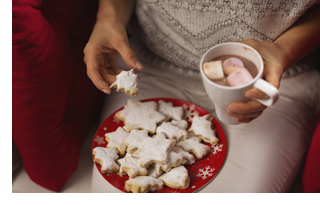
Getting back to those seasonal treats, holiday foods tend to be full of processed carbohydrates, which turn into sugar in your body. Picture the delicious spread of the cookies, candies, hot chocolate and mulled wine at your next gathering. Sugar, sugar and more sugar! In addition to all of the sugar there’s plenty of alcohol during the holidays. Many of my clients have made the connection that alcohol triggers their hot flashes. So this holiday season, say no thanks to all the sugar and alcohol and enjoy not having so many hot flashes.
Hot-flash-free holiday strategy
So, what is a good strategy for reducing hot flashes this holiday season, a time full of celebration and tradition? Your recipe for a hot-flash-free holiday season needs to include these three ingredients:
- Eat in balance BEFORE attending a party: Have a healthy snack including protein, fat and a veggie or fruit carbohydrate. For example, a balanced snack of cheese, olives and half an apple may keep your blood sugar stable, which keeps your hormones more balanced. This strategy also reduces the urge to eat those processed goodies at the party.
- Plan ahead: Bring alternative appetizers, side dishes, and beverages so you can avoid the holiday treats that create hot flashes and still enjoy yourself with the food festivities. Maybe you bring an appetizer of deviled eggs, veggies and dip, an olive tapenade, or a pumpkin custard treat. We are fans of the shaved Brussels sprouts and pomegranate salad or a dish of wild rice meatballs. Decide ahead of time what you will drink at the event instead of alcohol or something sweet. Sparkling water with lemon or lime would be a good choice. Instead of mulled wine or cider, try a hearty tea like the Good Earth® Original™ Sweet & Spicy™ Tea, a flavorful cinnamon spice tea perfect for the winter holiday. For a hot chocolate alternative, here’s a protein hot chocolate recipe or a hot chocolate smoothie that gives you the flavor profile while being a balanced snack in cup.
- If you do have sugar, make sure your NEXT meal is balanced: Sometimes you decide you want to partake in the wine or the cookies that make you feel nostalgic about holidays when you were a kid. Rather than waiting until the next day, Monday, or the new year to “start over”, eat something balanced at your very next meal (or even your very next bite!). Giving your body protein, healthy fat, and a veggie or fruit carbohydrate will help stabilize your blood sugar, cut the cravings, and lead to more balanced hormones with less hot flashes.
In preparation for next holiday season, start working on balancing your hormones throughout the year, so that you aren’t worried about hot flashes this time next year! Balancing hormones can feel like a complicated process because it can take some time and problem solving. But it’s doable and worth the effort!
Hot flashes are not a fun experience to go through and, although menopause is a natural stage of life, you don’t have to suffer through your holiday gatherings. Try eliminating the sugar, eating a balanced snack of protein, fat, and veggie or fruit carbs before events, bringing a dish to share, and remember you can eat in balance at your very next meal if you decide to taste the sweets or make merry with the alcohol. All of us at Nutritional Weight & Wellness wish you the happiest – hot-flash-free – holidays!
For more helpful information about hot flashes and menopause, check out these resources:
- Read: Menopause Diet: Can Nutrition Help Menopause Symptoms?
- Read: Ultimate Guide to Menopause
- Learn: Menopause Solutions online class
- Try: Chocolatey Fat Bombs or Stewed Apples with Coconut Butter for healthier alternative to the traditional treats
Resources:
- Delamater L, Santoro N. Clin Obstet Gynecol. 2018 Sep;61(3):419-432.
- Thurston, RC, El Khoundary SR, Sutton-Tyrrell, K, Crandall, CJ, Sternfeld, B, Joffee, H, Gold, EB, Selzer, F, Matthews KA. J Clin Endocrinol Metab. 2012 Oct; 97(10): 3487–3494.
Share This Article